


English > News > Latest News
Meet Bernie Huang, a 16-year-old AI coding talent
Source: Shenzhen DailyUpdated: 2026-05-09
Shenzhen is never short of young tech talents.
Bernie Huang Jinyuan, a 16-year-old sophomore in the senior high division of Shenzhen Experimental School in Nanshan District, has already open-sourced over 40 mini-programs of his own on GitHub, with over 100 code repositories.
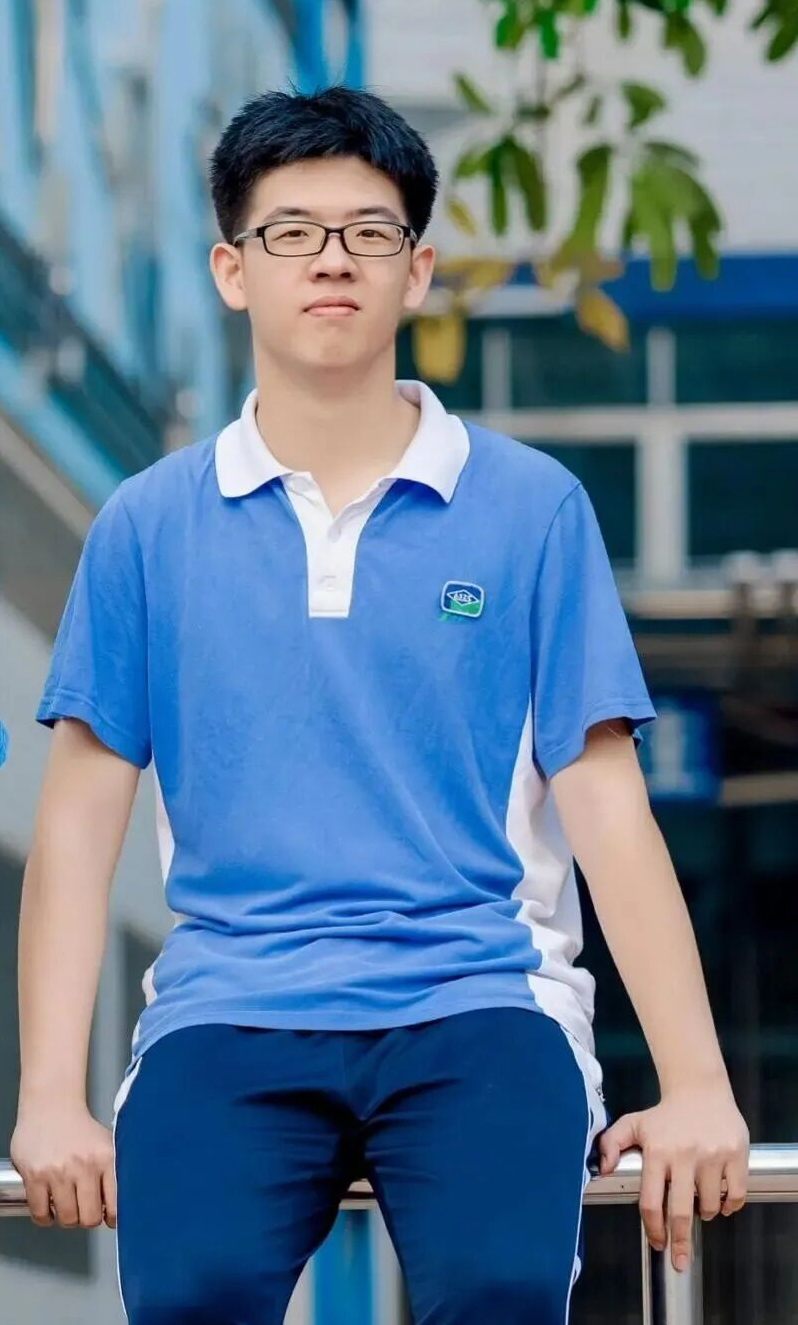
Bernie Huang Jinyuan.
At 14, he took the stage at the China Open Source Annual Conference (COSCon), delivering a five-minute speech. Together with Nathan Chen (a key contributor to a recent technical advancement by Chinese AI firm Moonshot that was praised by Elon Musk) and others, he co-founded OpenTeens, China's first youth open-source community. He has also completed the Microsoft AI Talent Program (ATP) for college students, been selected for the Tencent Rhino-bird Open-source Training Program, and participated in a summer research project at MIT.
Most of Huang's coding projects are aimed at solving everyday inconveniences.
For instance, he created a program that automatically orders his weekly meals at the campus canteen. The program sends the menu and his preferences to an AI, which then decides what he should eat the following week. He also built a physics simulation program that helps him analyze and calculate forces.
During his stay in Beijing for Microsoft's ATP university-level AI program, he and his team created a gesture recognition program that allows users to move the mouse, type text, and control the computer using hand gestures. "It's really cool," he said.
AI has greatly improved his efficiency. "It used to take two to three weeks to develop a mini-program. Now, with AI-assisted programming, I can make one in one or two hours," he said.
He has also contributed to SearXNG, a free, open-source metasearch engine, where he ranks among the top contributors.
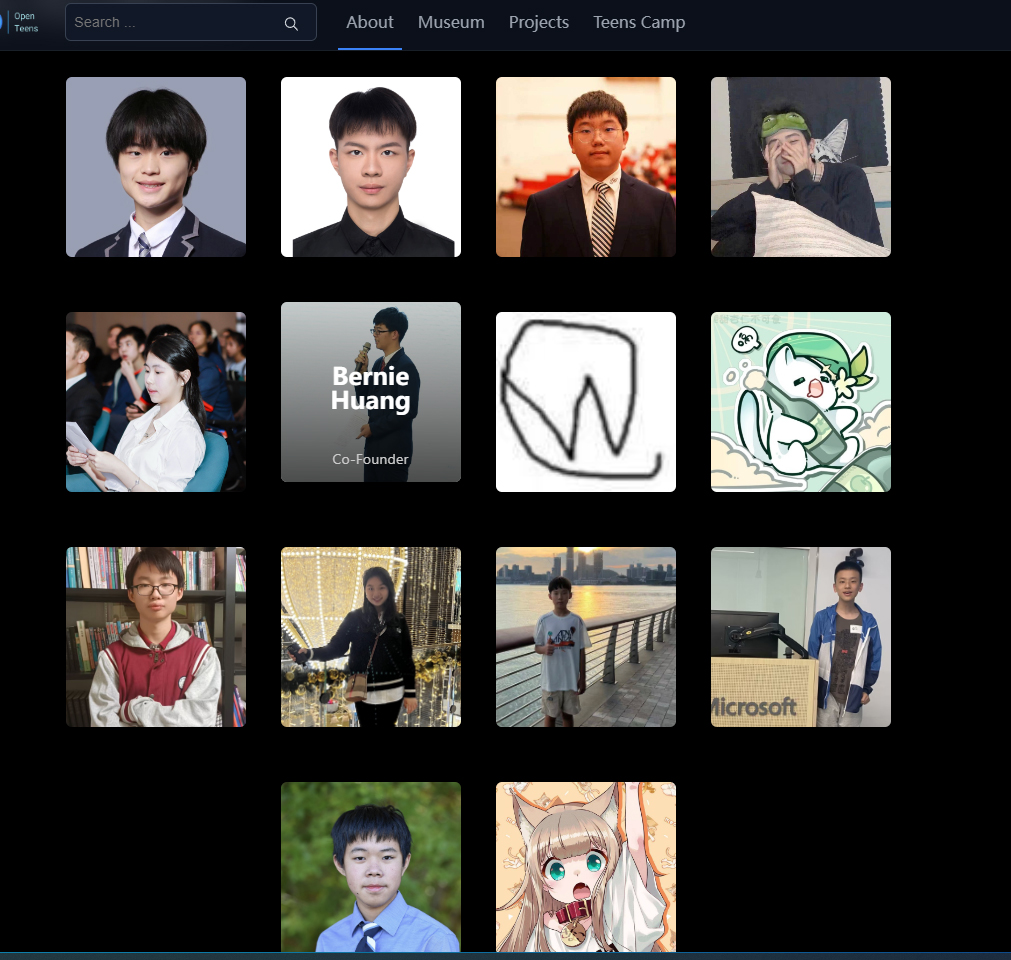
A screenshot of OpenTeens. At the top left is Nathan Chen, and second from the left on the second row is Bernie Huang.
Huang's path to programming started in third grade during computer class.
"That's when I learned Scratch (a programming language for beginners), and I was absolutely delighted. Mom allowed me 20 minutes every day at noon to code freely on the computer." By the time he graduated from primary school, Huang had turned almost every game idea he could think of into code, building a portfolio of 3 gigabytes.
In middle school, he joined SearXNG. "Back then, my skills weren't that advanced, but everyone in the open-source community was incredibly welcoming. They selflessly shared their code with me and taught me so much." That sense of gratitude made him determined to pass on the spirit of open source.
For peers who want to try programming but don't know where to start, his advice boils down to three "dares": dare to think, dare to do, dare to try.
"It's better to make mistakes in the controlled environment of school than in society later in life." He pointed to his own experience of 20 minutes each day in elementary school as proof: you don't need to wait until you're "ready" to start — because that day never comes.
Huang's future goal is not computer science, but biology.
"Biology is a truly inspiring field. From living organisms, we gain insights from tens of thousands of years of evolution," he said. "I want to combine the creativity of biology with the control of programming."
He is particularly interested in protein folding structure prediction — a cutting-edge application of AI in biology. "The most practical use of AI right now is predicting protein folding structures. Proteins can have thousands or tens of thousands of amino acids, and their three-dimensional structures are incredibly complex. But AI can predict their 3D structures and actual functions based on their amino acid sequences."
His vision goes even further: "I hope that in the future, I can look at a piece of DNA and know exactly what it can do and what traits it controls."
He noted that many people fear AI will replace their jobs, but he prefers to see AI as a mirror: the quality of your thinking determines the quality of its reflection.
"Humans and AI should each play to their strengths," he said. "AI's logical reasoning isn't perfect yet — it can make mistakes in long chains of deduction. What humans excel at is identifying problems and coming up with initial solutions, then using AI's vast knowledge to refine and implement them."
"I hope everyone doesn't just focus on studying — studying is certainly important — but also uses their free time to learn about these new things. At the very least, read the news. You don't need to fully understand AI principles, but you should know what AI can do. And one step further, learn how to use it."
"In the age of AI, the ability to ask questions may be more valuable than the ability to answer them," he concluded.

Copyright © Shenzhen Nanshan Information Network Center. All rights reserved.
Website ID:4403050037
ICP Registration Number:粤ICP备17157920号-1
 Police Registration Number:44030502001326