

New Zealand mayor impressed by Nanshan’s green tech
Source: Shenzhen DailyUpdated: 2026-06-18
After signing an upgraded sister-city agreement with Shenzhen on June 10, Christchurch Mayor Phil Mauger headed straight to the Nanshan Energy Ecological Park — one of the stops he was most looking forward to visiting.
Sipping coffee at the Sky Bar, perched atop the park's chimney, he marveled at the efficiency of the waste-to-energy facility as the picturesque Mawan cargo terminal unfolded outside the windows.

Christchurch Mayor Phil Mauger (C) listens as a representative introduces robotics technologies during a visit to Leju Robot in Shenzhen . Mauger toured several technology and infrastructure facilities during his visit to Shenzhen this week. File photos
The new agreement, signed at the Civic Center, elevates the previous friendly exchange relationship, established in 2015, to a formal, high-level sister-city partnership.
As a large-scale waste-to-energy plant, the Nanshan Energy Ecological Park processes 2,300 tons of household waste daily, converting it into electricity. Inside, the spacious exhibition hall feels more like an art gallery: Soil in the rose garden is made from incinerator ash and coffee grounds, a large art installation is assembled from mineral water bottles, and an elephant sculpture is crafted from recycled cardboard.
Through a floor-to-ceiling glass window, visitors can observe the incineration ash treatment system, while a diagram on the opposite wall illustrates the entire waste treatment process. Staff members guided the mayor and his delegation through the park's flue gas treatment, thermal energy utilization, and leachate and ash processing technologies.
In the central control room, a large screen displayed real-time emissions data. "From nitrogen oxides and hydrogen chloride to sulfur dioxide and dioxins, Shenzhen's standards are far lower than both European and Chinese national standards — something we are very proud of," a staff member explained.
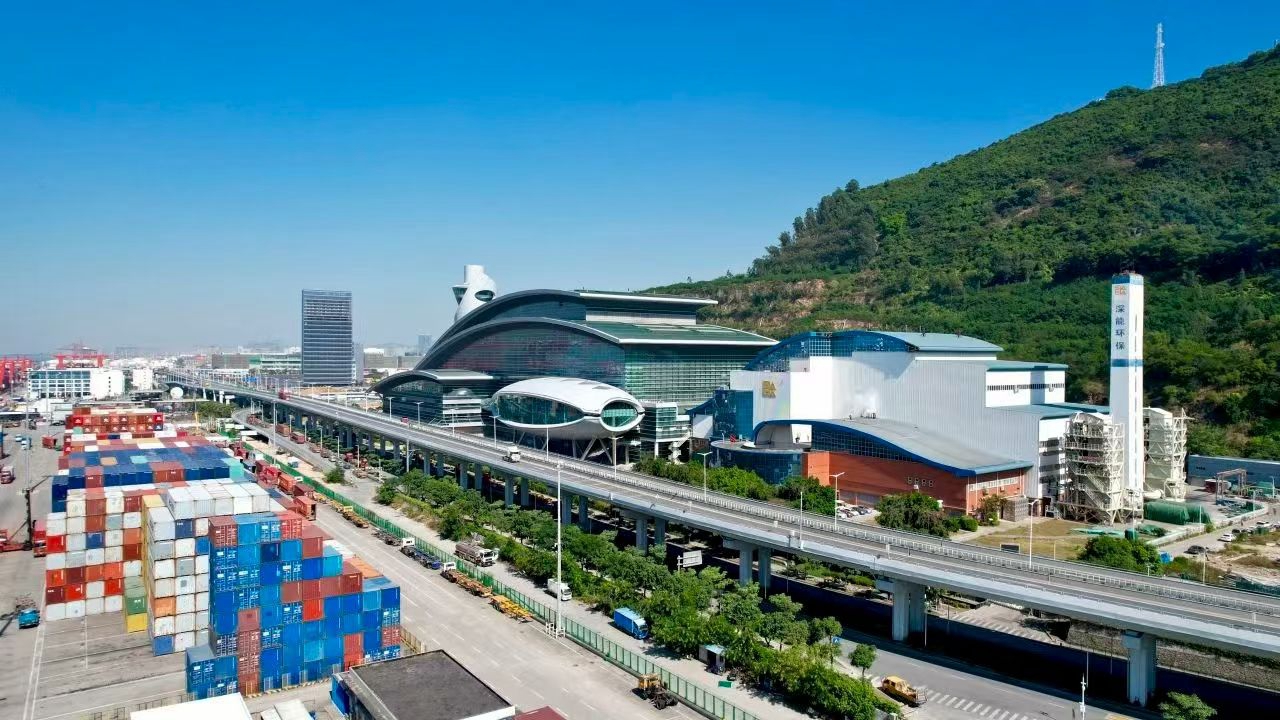
A general view of the Nanshan energy ecological park.
At the educational area, the mayor and his delegation tried their hand at a waste-sorting arcade game, adding a lighthearted moment to the visit.
Mauger was particularly struck by the contrast with New Zealand's current approach. "At home, we put everything into a landfill. It has capacity for more than 100 years, but one day it will be full," he said. "But this — the waste-to-energy approach — is much better."
He also acknowledged that chimney emissions remain a major challenge for New Zealand. "But it seems Shenzhen has really solved that problem well. So I'll take this information back and see what we can do."
The mayor also showed keen interest in the hydrogen technology being developed by Shenzhen Energy Group. "I like hydrogen," he said. "A hydrogen fuel cell produces zero greenhouse gas emissions."
At the end of the visit, Mauger extended an invitation to the Nanshan team, hoping they would visit Christchurch for further exchanges. "There is still a lot for us to catch up on," he admitted. "You sit at home thinking, 'we might try this, try that,' but then you come here and find you guys are already doing it. That's what I like the most."

Christchurch Mayor Phil Mauger (R) poses for a photo with a humanoid robot and company representatives during a visit to Leju Robot in Shenzhen.
With the new sister-city framework in place, Mauger said future cooperation would be much easier to coordinate. He identified two priority areas: waste-to-energy solutions and trackless trams — a technology he also observed during an earlier stop in Qingdao, Shandong Province.
Student exchanges and technology sharing are also on the agenda, promising deeper ties between the two cities.
 Copyright © Shenzhen Nanshan Information Network Center. All rights reserved.